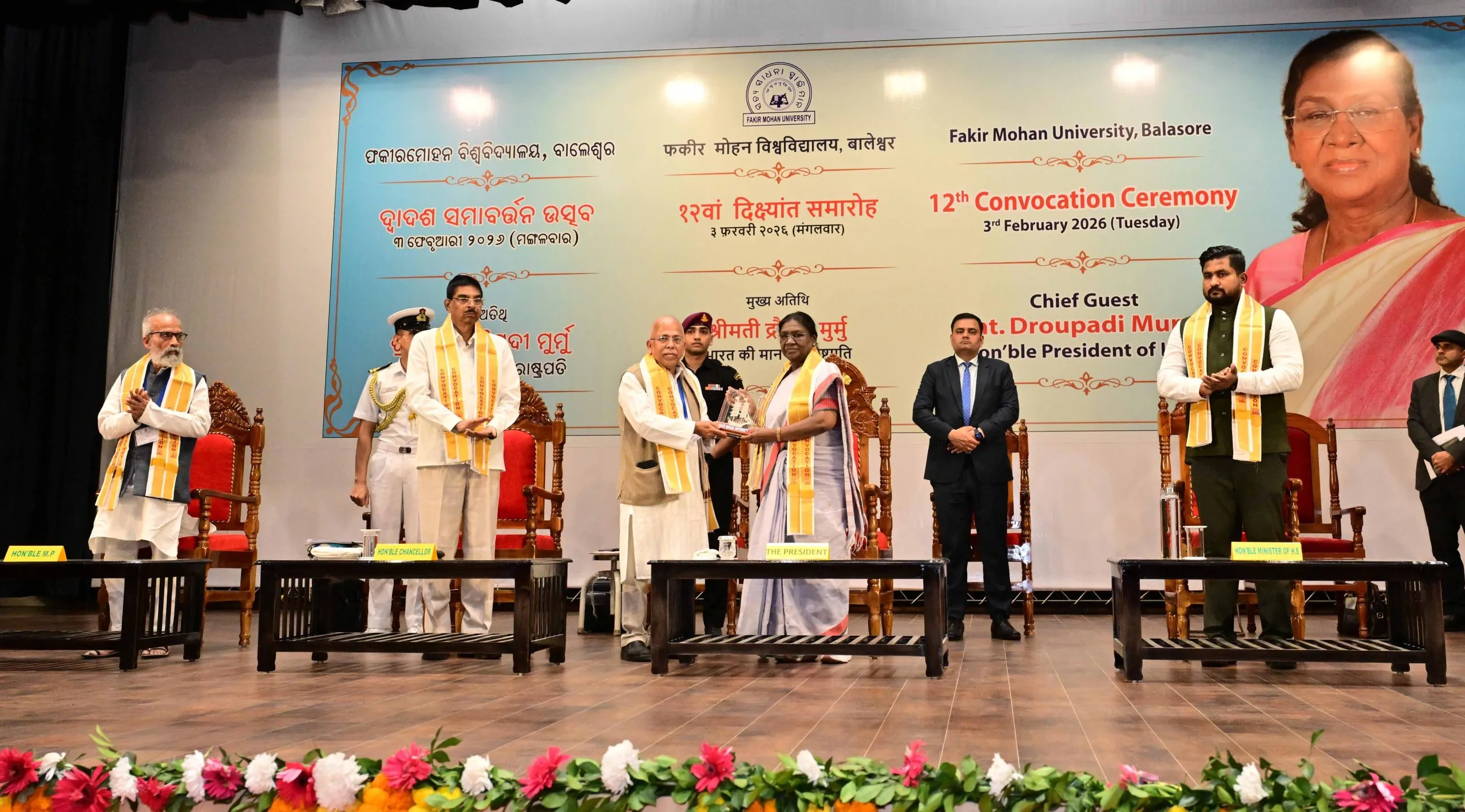
President Droupadi Murmu’s presence at the convocation ceremony of Fakir Mohan University marked a moment of pride not only for the institution but also for the larger academic community of Odisha. Addressing graduating students, faculty members, and administrators, the President underlined the critical role universities play in shaping an inclusive, equitable, and future-ready India. Her speech blended inspiration with responsibility, reminding young graduates that education is not merely a personal achievement but a national asset.
The convocation served as a platform to reflect on higher education’s evolving role in social transformation, economic development, and nation-building. President Murmu’s remarks resonated deeply in a time when India is striving to balance rapid growth with inclusivity.
Significance of the Convocation Ceremony
Convocation ceremonies represent a transition from structured academic life to professional and civic responsibilities. At Fakir Mohan University, the event symbolized years of hard work by students and the guiding role of educators who prepared them for real-world challenges.
President Murmu acknowledged the dedication of students who completed their degrees despite disruptions caused by global and domestic challenges in recent years. She emphasized that graduating from a university rooted in regional culture and history carries a unique responsibility to uplift local communities while contributing to national progress.
The ceremony also highlighted the university’s growth as a center of learning in eastern India, offering opportunities to students from diverse social and economic backgrounds.
President Murmu’s Vision for Inclusive Growth
In her address, President Murmu stressed that inclusive growth must remain at the heart of India’s development agenda. She described universities as engines of social mobility that can bridge gaps between privileged and marginalized sections of society.
According to her, higher education institutions must ensure that students from rural areas, tribal communities, and economically weaker backgrounds receive equal opportunities to learn, innovate, and lead. She noted that education is one of the most effective tools for reducing inequality and empowering communities.
The President urged universities to align academic goals with national priorities such as sustainable development, social justice, and innovation-driven growth.
Role of Universities in Nation-Building
President Murmu highlighted that universities are not limited to awarding degrees. They are spaces where ideas are debated, values are shaped, and leadership is cultivated. She encouraged institutions like Fakir Mohan University to promote critical thinking, ethical reasoning, and a sense of social responsibility among students.
She pointed out that universities must actively contribute to solving real-world problems through research and community engagement. Whether addressing climate change, public health challenges, or digital inclusion, academic institutions have the intellectual resources to offer meaningful solutions.
The President also emphasized collaboration between universities, industry, and government to ensure that education remains relevant and impactful.
Fakir Mohan University’s Contribution to Regional Development
Fakir Mohan University has played a vital role in expanding access to higher education in Odisha. President Murmu acknowledged the university’s efforts in catering to first-generation learners and students from underrepresented regions.
She praised initiatives that focus on skill development, vocational training, and interdisciplinary studies, which help students become employable and adaptable. By integrating local knowledge systems with modern education, the university strengthens its connection with the surrounding community.
The President encouraged the institution to further enhance research capacity and innovation ecosystems to support regional economic growth.
Education as a Tool for Social Empowerment
A key theme of President Murmu’s address was the transformative power of education. She reminded students that knowledge equips individuals not only with professional skills but also with the ability to challenge injustice and contribute positively to society.
She emphasized that graduates must remain sensitive to social realities and strive to uplift those who lack access to opportunities. Education, she said, should foster empathy, inclusiveness, and respect for diversity.
The President urged students to carry forward the values they learned during their academic journey and apply them in their personal and professional lives.
Encouraging Research and Innovation
President Murmu highlighted the importance of research and innovation in driving inclusive growth. She noted that universities must encourage students and faculty to pursue research that addresses local and national challenges.
From agriculture and renewable energy to healthcare and education technology, research outputs can directly impact the lives of millions. She called for increased focus on interdisciplinary research and collaboration with other institutions.
The President also stressed the need to support young researchers through mentorship, funding opportunities, and access to global academic networks.
Preparing Students for a Changing World
Addressing the graduating students directly, President Murmu spoke about the rapidly changing nature of work and society. She advised students to remain lifelong learners, adaptable to technological advancements and shifting economic landscapes.
She emphasized that while technical skills are essential, qualities such as integrity, teamwork, and resilience are equally important. Universities, she said, must focus on holistic development rather than narrow academic achievement.
The President encouraged students to embrace innovation while staying grounded in ethical values and cultural heritage.
Women, Youth, and Inclusive Education
President Murmu also highlighted the role of women and youth in shaping India’s future. She emphasized that inclusive education must ensure equal participation of women in all fields of study and research.
She encouraged universities to create safe, supportive, and empowering environments for female students and scholars. By promoting gender equality in education, institutions contribute to broader social transformation.
The President noted that India’s demographic advantage can be fully realized only if young people are equipped with quality education and opportunities to contribute meaningfully.
Message to Faculty and Administrators
President Murmu acknowledged the efforts of teachers and administrators who form the backbone of the education system. She emphasized that faculty members play a critical role in nurturing curiosity, discipline, and ethical values among students.
She urged academic leaders to continuously update curricula, adopt innovative teaching methods, and foster inclusive campus cultures. Administrative efficiency and transparency, she said, are essential for building trust and excellence in higher education.
The President also encouraged institutions to leverage technology to expand access and improve learning outcomes.
Conclusion
President Murmu’s address at the Fakir Mohan University convocation was a powerful reminder of education’s role in shaping an inclusive and progressive nation. By highlighting the responsibility of universities in promoting equitable growth, social empowerment, and innovation, she set a clear vision for the future of higher education in India.
For graduating students, the convocation marked both an achievement and a beginning. As they step into new roles, the values and insights shared by the President serve as guiding principles. Fakir Mohan University’s convocation thus became more than a ceremonial event; it stood as a reaffirmation of education’s enduring role in building a just and inclusive society.